Wednesday, November 29, 2017

Berserkers

Berserkers were Norse warriors who are reported in the Old Norse literature to have fought in a nearly uncontrollable, trance-like fury, a characteristic which later gave rise to the English word berserk.

They were said to wear the pelt of a wolf or bear when they entered battle. The name berserker derives from the Old Norse berserkr. This expression likely arose from their habit of wearing a kind of shirt or coat (serkr) made from the pelt of a bear (ber-) during battle. The bear was one of the animals representing Odin, and by wearing such a pelt the warriors sought to gain the strength of a bear and the favor of Odin. Berserkers are sometimes described as Odin's special warriors.
Berserkers appear prominently in sagas and poems, many of which describe them as ravenous men who loot, plunder, and kill indiscriminately. Later, Christian interpreters referred to the berserkers as a "heathen devils".

The berserker were said to be able to do things that normal humans could not. According to ancient legend, the berserkers were indestructible, and no weapon could break them from their trance. They were described as being immune to fire and to the strike of a sword, continuing on their rampage despite injury.
The fury of the berserkers would start with chills and teeth chattering and give way to a purpling of the face, as they literally became ‘hot-headed’, and culminating in a great, uncontrollable rage accompanied by grunts and howls.

Some claim that berserker behavior can be explained by the ingestion of the plant known as bog myrtle, one of the main ingredients in Nordic grog. Myrica gale is a species of flowering plant in the genus Myrica, native to northern and western Europe. It is a deciduous shrub.

Sardis - Ancient City of Gold

Croesus, King of Lydia, ruled from 561 to 547 BCE. He was the richest man in the world and his wealth was built on gold in abundance in the waters of the Pactolus River, which flowed through his capital, Sardis. The Lydians were the first people to mint coins of pure gold and silver.
Over the centuries, the remains of Sardis were covered over by waves of succeeding generations of invaders—first the Greeks, then the Romans, and finally the Byzantines. At the palace site researchers are making remarkable discoveries.
Arm of a fallen soldier, killed in the battle between Croesus and Cyrus. He died still clutching a small stone in his hand, which may have been a slingstone.
See ------>http://psjfactoids.blogspot.ca/2016/01/gold-of-croesus.html

Tuesday, November 28, 2017

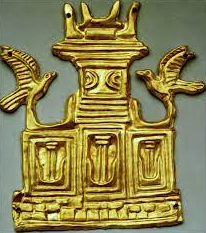
Minoan Gold


Minoan, about 1850-1550 BC. 'Master (or Mistress) of the Animals'
The Minoan civilization was a Bronze Age society that arose on the island of Crete and flourished from about the 27th century BC to the 15th century BC. The term "Minoan" was coined after the mythic King Minos. Minos was associated in Greek myth with the labyrinth, which identified with the site at Knossos.

According to Greek mythology, King Minos of Crete had the craftsman Daedalus construct the Labyrinth in order to conceal the Minotaur. The Minotaur was a half bull and half man creature that yearly ate the Athernian tribute of fourteen young men and women.
Salzburg Multiple lane labyrinth with Theseus and the Minotauros in the center.

The Bronze Age began in Crete as locals on the island developed centers of commerce. This enabled the upper classes to expand their influence. Eventually the ground would be laid for a monarchist power structure - a precondition for the creation of great empires.

Around 1450 BCE, Minoan culture experienced a turning point due to a natural catastrophe, possibly the eruption of Thera. (Santorin) The palace in Knossos seems to have remained largely intact. The Minoan palace sites were occupied by the Myceneans around 1420 BC.

By 1200 BC the Minoans had faded into history.


Signet ring dates to around 1500 BCE


See ----->http://psjfactoids.blogspot.ca/2016/02/santorini-thera.html

Monday, November 27, 2017

Jonathan, St. Helena's famous ancient tortoise


In his time on St Helena he has seen 28 British governors come and go.
Jonathan the giant tortoise is perhaps the world's oldest land animal, living in pampered luxury on the remote British island of St. Helena. Aged at least 185 -- though no one knows for certain -- Jonathan should prepare himself for an influx of visitors now that an airport has opened on the small island in the middle of the South Atlantic Ocean. The island's most famous resident, Jonathan slowly roams the lush gardens of the governor's house, eating carrots, lettuce, cucumber, apples and pears prepared in the governor's kitchen.
He appears on the island's five-pence coin, on immigration stamps, and in old black-and-white photographs alongside Boer War prisoners in the early 20th century. Jonathan originates from the Seychelles but his arrival on St. Helena remains a mystery and the exact year is disputed. Some unconfirmed reports suggest 1882 -- a few decades after Napoleon died in exile on the island on 1821.

He is now blind, has no sense of smell and is already far beyond his life expectancy of 150 years -- but otherwise he is in good health with good hearing.

St. Helena, located 1,200 miles (1,900 kilometers) from the African mainland, is one of the most remote places on Earth.

Sunday, November 26, 2017

Spectacular Ancient Bronze

Dated to around 330 BC, the bronze Boxer at Rest is a Hellenistic Greek sculpture of a sitting nude boxer at rest, still wearing his caestus, a type of leather hand-wrap, in the collection of the National Museum of Rome.  The Boxer was discovered in 1885, possibly from the remains of the Baths of Constantine.
“Portrait of Seuthes III” (about 310-300 B.C.), Greek. Bronze, copper, calcite, alabaster, and glass. Seuthes III was a ruler of the Odrysian kingdom of Thrace from 331 BC to ca. 300 BC. This bronze was found in his tomb.

“The Medici Riccardi Horse” About 350 B.C. Italian Bronze and gold.
The bronze "Chimera of Arezzo" is one of the best known examples of the art of the Etruscans. It was found in Arezzo, an ancient Etruscan and Roman city in Tuscany, in 1553.

Inscribed on its right foreleg is an inscription, TINSCVIL, showing that the bronze was a votive object dedicated to the supreme Etruscan god of day, Tin or Tinia. The statue is estimated to have been created around 400 BC.
The over-lifesize "Dancing Satyr" of Mazara del Vallo is a Greek bronze statue recovered from the sea floor at a depth of 500m (1600 ft.) off the southwestern coast of Sicily in 1998.

The satyr is depicted in mid-leap, head thrown back ecstatically and back arched, his hair swinging with the movement of his head. The figure is highly refined; the whites of his eyes are inlays of white alabaster.
Artemis and the Stag is an early Roman Imperial or Hellenistic bronze sculpture of the ancient Greek goddess Artemis. In June 2007 the statue fetched $28.6 million at auction, the highest sale price of any sculpture at the time.

The statue depicts Artemis, the Greek goddess of hunting and wild animals. She stands in a pose that suggests she has just released an arrow from her bow. At some point in its history, the bow was separated from the sculpture and was lost.
Alexander the Great on Horseback, 100-1 B.C., bronze and silver.

Victorious Athlete, "The Getty Bronze" 300-100 B.C.

Popcorn

Popcorn is a truly ancient snack. Archaeologists have uncovered popcorn kernels that are 4,000 years old. They were so well-preserved, they ...