Saturday, June 30, 2018

Tyrian Purple

The ultimate status symbol in Ancient Rome was a set of robes died Tyrian purple. This colour, named for Tyre, its place of origin, was made from the secretion of a particular sort of sea snail called a Murex. It took 13,000 snails to produce just 28 millilitres of dye, enough for the trim on one garment. In Republican Rome only the wealthiest men, the equites, were allowed to wear it, but in Imperial Rome it was restricted to just the Emperor, as a symbol of his power.
Tyrian purple may first have been used by the ancient Phoenicians as early as 1570 BC. The dye was greatly prized in antiquity because the colour did not easily fade, but instead became brighter with weathering and sunlight. Its significance is such that the name Phoenicia means 'land of purple.' It came in various shades, the most prized being that of "blackish clotted blood".

True Tyrian purple, like most high-chroma pigments, cannot be accurately displayed on a computer display.

Friday, June 29, 2018

Crippled Pompeii Man Suffocated

With his skull in hand, experts believe that the man died from being suffocated by the volcanic ash that rained down on Pompeii, rather than being squashed by the rock. Archaeologists discovered a “treasure trove” of silver and bronze coins that he had been carrying in a leather pouch. It contained 22 coins, worth 80 sestertii, enough to sustain a family for two weeks. The skeleton was found in an area of new excavations, close to a newly-discovered alleyway of houses with balconies.
Excavations of the ancient Roman city of Pompeii have revealed the skeleton of a man who may have been decapitated by a large stone block as he fled from the catastrophic 79 C.E. eruption of Mount Vesuvius. Possibly hampered by a bone infection, archaeologists think he fled through an alleyway after surviving the first ejections of ash and debris that rained down on the city. He eventually met his demise when struck by a tumbling block. His body was found at roughly the same height as the second floor of a nearby building, suggesting he ventured outside after the first phase of raining ash had settled.

Lesions at the tibia suggest he was suffering from a bone infection. This could have hindered his movements and stopped him leaving Pompeii when the volcano first erupted.
The man was found in an alleyway above a thick layer of lapilli—debris thrown from the erupting Vesuvius. Archaeologists are currently excavating areas of the city which have not yet been fully explored. This is the latest archaeological discovery in Pompeii, after excavations recently yielded the body of a child and a horse.
See -----> Remains of ancient horse discovered at Pompeii
See ----->The Curse of Pompeii
See ----->Skeletons And Ancient Gold Coins Found at Pompeii Excavation

Thursday, June 28, 2018

Ancient Roman ‘hand of god’ discovered near Hadrian’s Wall

The hand is made of 2.3 kilos of solid bronze – and was almost certainly an offering to a military deity for giving the Romans victory in the largest military combat operation ever carried out in Britain, before or since. The Roman invasion of Caledonia was launched in 208 by Roman emperor Septimius Severus. The invasion lasted until late 210 when the emperor became ill and died. Some 50,000 Romans were in the invasion force. Thousands of tribespeople in what is now Scotland were killed.

It's likely the bronze hand was ritually buried after the conflict. The bronze hand is associated with a Roman god called Jupiter Dolichenus.

Tuesday, June 26, 2018

Cancer found in Ancient Egyptions

This ancient woman died of breast cancer.Archaeologists have found six cases of cancer while studying the bodies of ancient Egyptians who were buried in the Dakhleh Oasis. The finds include a toddler with leukemia, a mummified man with rectal cancer and individuals with cancer possibly caused by human papillomavirus (HPV).
In five of the six cases, scientists determined that they had cancer by studying lesions (holes and bone damage) on their skeletons. Those holes were left when cancer spread throughout their bodies. Researchers cannot be certain where the cancers originated in many of the cases.
Researchers believe the risk of cancer was considerably lower in ancient Egypt than it is today.

Monday, June 25, 2018

Amazing Shipwrecks


A bronze sword is among the artifacts. The 18-inch-long (45-centimeter) sword is of a style dated to between 950 and 850 B.C.
The Salcombe Wreck. Between 1200 and 900 B.C., a ship sank off the coast of Devon in England. Divers have so far uncovered 300 artifacts that weigh over 185 lbs combined, including copper and tin ingots (used to make bronze), weapons, and several pieces of jewelry. The wreck is significant because of its age and because the artifacts have proven that a trade network existed during the Bronze Age.
Golden adornments called torques which date to between 1300 and 1100 B.C.
The Belitung Shipwreck. The Belitung shipwreck was the first Arabian ship to be discovered and excavated. Found off the coast of Indonesia in 1998, it has yielded the richest and largest assortment of early ninth century Tang Dynasty gold and ceramic artifacts ever found–bowls, spice jars, inkwells, funeral urns, crystals, and gilt-silver boxes. Items included pearls from the Gulf, rubies and sapphires, a gold cup, and a silver flask.
The Antikythera Treasures. In 1900, divers discovered an ancient shipwreck just off the island of Antikythera. Another expedition in 1976 recovered the most significant part of the cargo. The massive haul of artifacts from the wreck included the Antikythera mechanism.

Coins and jewelry, glassware, pottery, statues, and even copper couch beds were found. One statue is a classical bronze statue made sometime from 340 to 330 B.C. named Statue of a Youth.
The Bom Jesus. The Bom Jesus was a Portuguese ship which sailed in 1533 and disappeared off the coast of West Africa. Geologists working for De Beers discovered the shipwreck buried in the beach. After uncovering several copper ingots, the mining operation was stopped and archaeologists were called in. It is the oldest shipwreck ever to be found off Africa’s coast and contained more than 22 tons of copper ingots, 6 cannons, swords, thousands of gold coins traced back to King João III, and more than 50 elephant tusks.
The Ghost Ship was accidentally discovered in 2003 by a crew searching for a Swedish plane shot down in WWII on the Baltic Sea. A full-scale expedition was launched in 2010, and researchers were able to confirm that the ship was built around 1650.

It is believed to be a type of Dutch ship known as a fluyt (a sailing cargo ship). The waters of the Baltic Sea have almost no tidal movement and the low salinity means shipworms are not able to inhabit it. That’s why the Baltic houses some of the most ancient and well-preserved vessels in the world.
The Vasa. The most exquisite shipwreck ever to be found in the Baltic Sea was the Swedish royal warship, the Vasa. Built between 1626 and 1628, it sank on its maiden voyage, less than a nautical mile from the harbor.
During a recovery operation in 1961, thousands of artifacts and human remains were removed. The wreck was so well-preserved that the smallest details could still be discerned on its artwork. It took more than eighteen months and 1,300 dives to salvage the Vasa. The Vasa museum is one of the most popular tourist attractions in Sweden.


Sunday, June 24, 2018

Ancient gold coin discovered at Abuqir Bay in Alexandria

A gold coin from the Islamic period was discovered by an Egyptian-French mission during an underwater excavation at Abuqir Bay in Alexandria.

The gold dinar dates to the reign of the Omayyad Sultan Abdel Malek Ibn Marawan (646 – 705).

Saturday, June 23, 2018

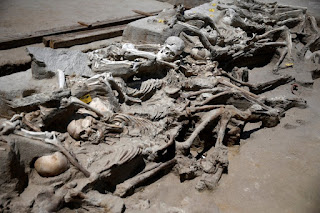
More than 80 shackled skeletons found in ancient mass grave

In 2016 archaeologists found a mass grave near Athens, Greece, containing more than 80 skeletons. The wrists of the skeletons were all bound in iron shackles.

Archaeologists believe they were part of a mass execution.
The skeletons were found in the Falyron Delta necropolis, between Athens and the port of Piraeus. It’s believed that the victims may have been part of a failed coup plot, supporters of Cylon, who attempted to take over Athens. Cylon was an Athenian noble who attempted to seize power in the city in 632 BCE, where his father-in-law, Theagenes, was tyrant.

The coup was opposed, and Cylon and his supporters took refuge in Athena's temple on the Acropolis. Cylon and his brother escaped, but his followers were cornered by Athens' nine archons and killed.

Popcorn

Popcorn is a truly ancient snack. Archaeologists have uncovered popcorn kernels that are 4,000 years old. They were so well-preserved, they ...